Biometrics answer “is this the enrolled person?” Contractor access control must answer “is this verified person currently eligible to enter this site, through this gate, for this assignment, at this time?” The strongest design keeps those questions separate and combines their results only when making the entry decision.
Why a biometric match is necessary—but not sufficient
Traditional contractor access often begins with a plastic badge, spreadsheet, email approval, or name on a security list. These methods can work for a small site, but they become difficult to control when projects have several contractors and subcontractors, workers move between locations, assignments change, documents expire, and shift peaks bring hundreds of people to the gate in a short period.
A biometric checkpoint improves the link between the physical person and the contractor record. Face, fingerprint, iris, or another suitable modality can reduce badge sharing and make attendance events more attributable. That is valuable, but a correct identity match does not prove the person is ready for today's work.
Official contractor-management guidance consistently treats competence, coordination, induction, supervision, site rules, and current qualifications as operational responsibilities—not as facts that can be inferred from a person's identity. The UK Health and Safety Executive, for example, highlights contractor selection, coordination, site induction, supervision, competence, and review as connected parts of contractor management. Its construction guidance also states that site rules and site-specific inductions are required, with topics including restricted areas, hot work, traffic management, permit-to-work systems, and emergency arrangements.

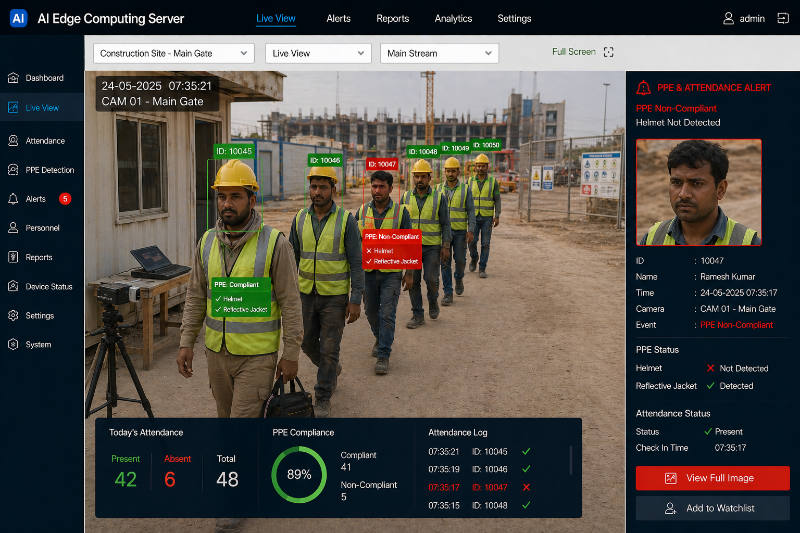
The access system should not become the contractor database
An access-control platform is normally good at readers, controllers, doors, time schedules, credentials, anti-passback, and access events. It may not be the right place to manage company insurance, trade licences, worker categories, training evidence, project sponsorship, induction validity, subcontractor relationships, or mobilization approvals.
Trying to force all contractor governance into access-control notes and badge fields creates weak ownership. Security personnel may be asked to interpret safety documents; procurement updates may not reach the gate; and permissions can remain active long after the underlying assignment changes. A contractor-management layer should own the eligibility facts and provide the access system with a clear, current decision or policy status.
The contractor system should not open the door by itself
The reverse separation is equally important. Contractor software may confirm that a worker has met onboarding requirements, but physical access still depends on the entrance, controller, barrier, direction of travel, anti-passback state, emergency mode, and local operating conditions. A joined design allows each platform to remain responsible for the decision it understands.
| Gate question | Primary source | Example result | Why it can change |
|---|---|---|---|
| Who is presenting? | Biometric identity and enrollment record | Verified worker 10584 | Template quality, re-enrollment, identity correction, or match exception |
| Who employs or sponsors them? | Contractor company and relationship record | Approved subcontractor under Package B | Company status, subcontract change, suspension, or contract completion |
| Are they ready? | Documents, competence, induction, and compliance rules | Electrical category approved; site induction current | Expiry, revocation, new evidence, or changed site requirement |
| Are they assigned here? | Project, work order, sponsor, or mobilization record | Assigned to Site 4 until 18 October | Transfer, schedule change, demobilization, or sponsor withdrawal |
| May they pass this point now? | Access policy, controller state, and site conditions | Gate 2 allowed, process area denied | Time, zone, emergency status, anti-passback, or local restriction |
What a trustworthy contractor eligibility record needs
The useful record is not a folder of uploaded documents. It is a structured, time-aware view of whether a company and worker meet the rules that apply to a particular site and assignment. Requirements vary by industry and jurisdiction, but six layers appear repeatedly in well-controlled contractor operations.
1. Contractor-company approval
The company record can include legal and commercial identity, approval status, insurance or licence evidence, contract dates, scope categories, responsible contacts, subcontractor relationships, and any site or business unit restrictions. A worker should not remain eligible when the employing company is suspended or its relevant engagement has ended.
2. Verified worker identity
Names alone are not stable identifiers. Transliteration, duplicate names, spelling differences, shared phone numbers, and repeated mobilizations can create multiple records for the same person. An enrollment process should resolve the worker record, capture the required evidence, check for duplicates appropriate to the program, and bind the selected biometric or credential to that record.
3. Assignment and sponsorship
A competent worker employed by an approved company may still have no current reason to enter a specific project. The record should identify the sponsor, project, package, work order, location, expected dates, role, shift, and whether unescorted access is permitted. Assignment is what turns general approval into a site-specific relationship.
4. Competence, training, and induction
Different activities require different evidence. A general site induction does not prove competence to operate equipment, perform electrical work, enter a confined space, or supervise a lifting operation. Rules should map worker categories and planned activities to the evidence required, including validity dates and the authority that accepted it.
5. Health, safety, and policy declarations
Sites may require acknowledgements, medical fitness information, screening, PPE confirmation, language-specific instructions, or other controlled checks. These requirements should be collected only where justified, protected according to sensitivity, and exposed to gate operators as a decision status rather than unnecessary detail.
6. Current restrictions and exceptions
A suspension, investigation hold, failed induction, missing escort, denied attempt, emergency restriction, or temporary exemption can change the outcome immediately. The system needs effective dates, reason codes, responsible approvers, and audit history so an exception does not become an invisible permanent bypass.
The contractor journey begins before the gate and ends after access is removed
Review the organization, scope, evidence, ownership, and contractual relationship.
Resolve identity, capture required evidence, and create one accountable person record.
Connect the person to a sponsor, site, package, role, dates, shift, and zones.
Evaluate documents, competence, training, induction, declarations, and exceptions.
Combine live eligibility with biometric verification and the local access policy.
Record entry, exit, current presence, denied attempts, and assisted decisions.
Respond to expiry, transfer, suspension, permit status, or a changed site condition.
Remove access, close the assignment, recover credentials, and retain the required audit record.
Pre-mobilization moves exceptions away from the queue
If the first serious review occurs when a worker is standing at the gate, the entrance becomes a document office, training desk, help centre, and approval queue. Pre-mobilization allows contractor administrators, sponsors, safety teams, and workers to resolve missing evidence before the shift begins. The gate can then concentrate on identity, current status, and physical passage.
Expiry should change eligibility automatically
Uploading a certificate is only the beginning. The system should extract or record its type, issuer, validity, applicable role, approval status, and expiry. Notifications can prompt renewal in advance, but once a mandatory item expires, the access outcome should follow the configured policy without relying on somebody to remember to deactivate a badge.
Offboarding is an access-control function
Contractor access can outlive the reason it was granted. Project completion, company removal, worker transfer, contract termination, or sponsor withdrawal should trigger a controlled review and timely revocation. The organization should be able to answer which permissions were removed, when, why, and by whom.
Build a current decision instead of a permanent “approved” flag
A single green status is easy to display but often too simple to govern. Eligibility should be evaluated from rules that know their scope and effective time. A worker might be approved for the site but not for a process area, valid for day shift but not night shift, or trained for general work but unable to start the high-risk task until a permit is active.
- Live face or fingerprint matches the enrolled worker
- Enrollment is active and not superseded
- Capture quality and presentation-attack controls meet policy
- An assisted alternative exists for genuine exceptions
- Company and assignment are active
- Required readiness evidence is current
- Site, time, gate, zone, and escort rules are satisfied
- No suspension, expiry, anti-passback, or emergency rule blocks entry
Permit to work and access permission are related, not identical
Physical access authorizes a person to cross a controlled boundary. An electronic permit to work authorizes defined work under specified hazards, controls, roles, location, and time. Entering the site should not automatically authorize hot work, confined-space entry, isolation, excavation, or another controlled activity.
Where the operating model requires it, Biometriya ePTW can use the same trusted contractor identity while maintaining a separate permit lifecycle. This enables useful policies—for example, confirming that the performing authority is present, that named workers match the permit team, or that access to a controlled work area aligns with an active permit—without confusing a gate transaction with permission to perform the job.
Attendance is not the same as current presence
A successful entry can support attendance, but a reliable site count also needs direction, confirmed passage, exits, re-entry, missed events, mobile checkpoints, vehicle passengers, and manual corrections. The live accountability view should distinguish inside, outside, entry pending, exit pending, denied, and unknown states rather than treating every successful match as proof that a person remains on site.
Design for throughput, exceptions, offline operation, and governance
Peak shift traffic exposes slow policy design
The biometric matcher may return quickly while the overall transaction waits on a remote document system, several sequential integrations, or an unclear exception. Test the full journey at realistic shift volumes: approach, capture, identity resolution, policy evaluation, controller response, barrier movement, confirmed passage, and queue recovery.
Biometriya FacePass can provide a controlled touchless checkpoint for recurring worker traffic. A BMBT rugged biometric tablet can support assisted enrollment, mobile checks, remote sites, temporary gates, or a separate exception lane. The device choice should follow the gate layout and assurance requirement rather than forcing every entrance into one pattern.
Exception handling should preserve both fairness and control
A false rejection, damaged fingerprint, changed appearance, missing synchronization, or expired record does not automatically mean fraud. It also should not become an unrecorded override. A controlled process can guide retries, check an alternative modality or evidence, route the case to an authorized operator, record the reason, restrict the resulting access, and expire any temporary decision.
Offline policy must be explicit
Remote construction sites and industrial gates cannot assume perfect connectivity. Define which identities and policies may be cached, how recently eligibility must have been synchronized, which changes must revoke local access immediately, how transactions are queued, and what happens when confidence is insufficient. A fail-open rule may create unacceptable risk; an indiscriminate fail-closed rule can strand an entire shift. The correct mode depends on the site and should be documented.
Give each team the decision it owns
Procurement or vendor management may approve companies. Project sponsors may authorize assignments. Safety teams may define induction and competence rules. Security may own gates, zones, and investigations. Contractor companies may maintain worker evidence. A good platform makes these responsibilities visible and prevents one team from silently approving facts owned by another.
Protect the worker record
Contractor files can contain identity evidence, biometrics, contact information, training, access history, health-related information, and investigation records. Apply purpose limitation, role-based access, retention schedules, encryption, audit logs, and jurisdiction-appropriate notices and legal review. Gate operators normally need an actionable status and reason—not unrestricted access to every underlying document.
Measure whether the system improves the operation
Useful indicators include company onboarding time, worker readiness before mobilization, documents expiring within the next 30 days, first-time gate success, identity-capture retries, denied attempts by reason, manual override rate, exception resolution time, peak queue length, access revocation latency, unknown presence states, and differences between scheduled and actual contractor attendance.
Questions to ask before selecting contractor access technology
- Identity: How is one worker resolved across companies, projects, repeat mobilizations, and different spellings?
- Company control: Can a company suspension or contract closure affect every relevant worker without manual badge searches?
- Rules: Can readiness requirements vary by site, worker category, role, activity, and zone?
- Time: Are effective dates, expiry, grace periods, and future assignments handled explicitly?
- Integration: How are eligibility changes delivered to access controllers, devices, ePTW, workforce, and reporting systems?
- Resilience: What happens at temporary gates, remote sites, and during network or server failure?
- Exceptions: Who can override a result, for how long, on what evidence, and with what audit trail?
- Offboarding: How quickly can permissions be removed when a worker, company, sponsor, or assignment changes?
The aim is not to make every contractor complete the maximum possible process. It is to make the entry decision explainable and proportionate: the right person, working for an accepted company, assigned to the right work, meeting the applicable requirements, entering the permitted place at the permitted time.
Frequently asked questions
Why is a biometric reader better than a contractor badge alone?
A badge proves possession of a credential and can be shared. A biometric transaction can connect the person at the gate to the enrolled worker record. The system must still check current contractor eligibility and access policy before opening the barrier.
Should an expired contractor document automatically block access?
That depends on the document, worker role, site policy, jurisdiction, and consequence of expiry. Mandatory readiness items can be configured to block entry, while lower-risk evidence may create a warning or review. The rule, responsible owner, grace period, and exception process should be documented.
Can contractor access control work at temporary construction gates?
Yes. Fixed terminals can serve established high-volume lanes, while rugged mobile biometric devices can support temporary gates, remote areas, assisted verification, registration, and exceptions. Connectivity and offline policy should be designed before deployment.
Is contractor access the same as contractor attendance?
No. Entry and exit events can contribute to attendance and presence, but time rules, paid hours, breaks, confirmed passage, missed exits, mobile work, and payroll policy may require additional processing. Access evidence should remain traceable rather than being treated as an unquestioned timesheet.
Does an active permit to work mean the worker can enter the site?
Not automatically. A permit authorizes specified work under defined controls. Physical access authorizes movement through a controlled boundary. Connected systems can evaluate both, but each decision should remain explicit.
Reference standards and independent resources
- UK HSE: Human factors—contractors — key principles covering contractor selection, coordination, induction, supervision, competence, hazards, and review.
- UK HSE: Site rules and induction — guidance on site-specific induction, restricted areas, permit-to-work systems, emergency arrangements, and other site rules.
- UK HSE: Are you a contractor? — construction guidance on planning, competence, skills, knowledge, experience, and training.
- ISO/TC 283 FAQ on ISO 45001 — official committee explanations concerning contractors, outsourced processes, procurement, and occupational health and safety management.