CCTV facial analytics and dedicated face terminals are not interchangeable. Video analytics are useful for awareness, observation, and open-area identification. A dedicated terminal creates a more controlled capture point for an explicit entry transaction. High-volume sites often benefit from a hybrid design in which the terminal makes the access decision while video analytics provide context, exception visibility, and operational intelligence.
What high-throughput biometric access control really means
In access control, throughput is the number of legitimate people who can pass a checkpoint safely and consistently during a defined period. That sounds like a device specification, but it is actually a system outcome. A fast matcher cannot compensate for poor user positioning, slow door mechanics, an overloaded network, unclear instructions, an expired contractor record, or a security officer who must resolve every exception manually.
The useful measurement is therefore not “faces per second.” It is the complete time from a person entering the recognition zone to the system producing an auditable access result and the person clearing the lane. A realistic design also measures queue length, unsuccessful capture attempts, false rejections, policy failures, manual interventions, and the time needed to recover when a person is not recognized.
This distinction matters at factories, construction projects, corporate campuses, airports, transport facilities, and large events. Traffic is rarely even. The system must survive concentrated demand at shift changes, contractor mobilization, meeting arrivals, boarding windows, or emergency transitions without weakening the access policy.
CCTV facial analytics versus dedicated face terminals
Both approaches use cameras and face algorithms, but they begin with different operating assumptions. CCTV analytics observe people moving through a scene. A dedicated biometric terminal asks a person to present their face within a designed capture zone. That difference affects image quality, user intent, liveness options, decision confidence, and the operational meaning of the result.
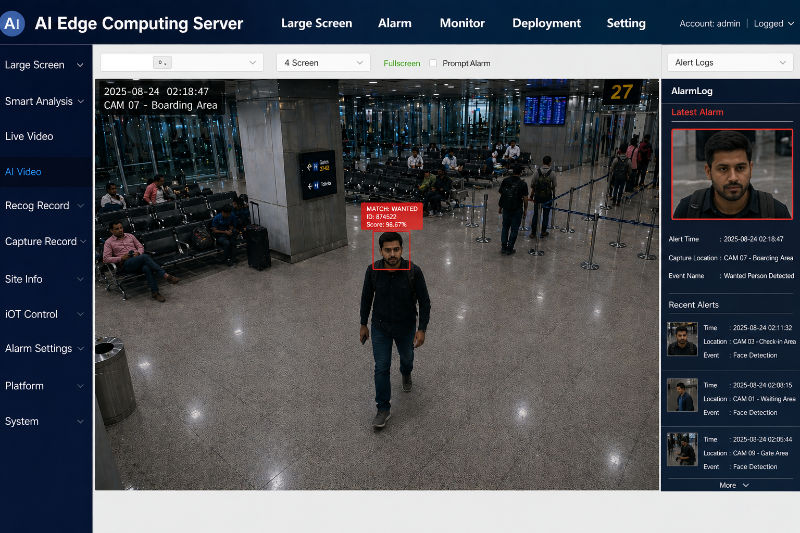

Video-based recognition from CCTV
Video analytics can detect faces in a field of view, select useful frames, compare them with a watchlist or enrolled gallery, and create events for an operator or connected system. This is valuable when an organization wants to add intelligence to existing cameras, monitor approaches to a restricted area, identify a person of interest, or understand movement without requiring every individual to stop.
The trade-off is less control over capture. People may look away from the camera, walk at different speeds, appear at different distances, or be affected by backlighting, shadows, occlusion, compression, and elevated camera angles. NIST’s Face in Video Evaluation specifically studies recognition of non-cooperative subjects and challenging video conditions because performance in these scenes is different from performance at a guided terminal.
Dedicated walk-through face terminals
A dedicated face recognition terminal is positioned for a deliberate identity transaction. The distance, camera angle, illumination, display guidance, and interaction zone can be designed around the checkpoint. The user understands that a decision is taking place, and the device can return immediate instructions such as move closer, look at the camera, try again, or contact reception.
This controlled encounter makes a terminal well suited to doors, turnstiles, visitor lanes, staff entrances, and contractor gates. It can also support liveness detection, local identity processing, relay or controller integration, and a clear user result. Biometriya FacePass is designed for this type of fast, touchless access and checkpoint verification.
| Design question | CCTV facial analytics | Dedicated face terminal |
|---|---|---|
| Primary role | Observe, detect, search, alert, and add scene context | Perform an intentional identity and entry transaction |
| Capture conditions | Variable distance, pose, lighting, movement, and camera angle | Designed distance, framing, illumination, and user guidance |
| User cooperation | May be passive or non-cooperative | Normally cooperative or lightly guided |
| Typical match mode | Often one-to-many identification against a gallery or watchlist | Identification or verification tied to a known access population |
| Access result | Usually requires orchestration with other systems before opening a barrier | Designed to return a direct allow, deny, or exception result |
| Best fit | Approach monitoring, open-area awareness, existing CCTV estates, investigations | Doors, gates, turnstiles, visitor entry, workforce and contractor checkpoints |
Recognition is only one input to the access decision
A biometric match answers an identity question: does the captured face correspond closely enough to an enrolled record under the configured threshold? Access control must answer a broader question: should this verified person enter this location now?
That decision may depend on employment status, contractor company, host approval, induction, certification, current permit, shift, zone, anti-passback state, visitor validity, or an active security restriction. Opening the door directly from a face match without checking these conditions can make a technically impressive system operationally weak.
Biometriya designs the biometric step as part of an identity-and-policy chain. For example, an invited visitor may be recognized by FacePass, but Biometriya Visitor Management System still determines whether the visit is approved and valid. A contractor can present the correct face while the contractor management workflow finds an expired document or inactive assignment. The access decision must reflect both identity and current eligibility.
Seven factors that determine real checkpoint throughput
1. Capture-zone design
Camera height, face size in the image, approach angle, illumination, background, walking path, and user distance affect the quality of the biometric sample. NIST research on face quality in video identifies pose, face size, detection confidence, environmental conditions, activity, and sensor characteristics as relevant factors. A site survey and representative testing are more reliable than assuming laboratory performance will transfer unchanged to the entrance.
2. Matching mode and population size
One-to-one verification asks whether a person matches a claimed identity. One-to-many identification searches a gallery to determine who the person may be. Both can be appropriate, but they have different performance, privacy, and exception-handling implications. The enrolled population, template quality, decision threshold, and expected traffic must be considered together.
3. Presentation attack detection and liveness
A high-speed lane still needs protection against printed photographs, replayed images, masks, and other presentation attacks appropriate to the threat model. ISO/IEC 30107 provides the framework and terminology for biometric presentation attack detection. Liveness should be evaluated as part of the complete capture and security design, not treated as a label that guarantees every spoof will be detected.
4. Physical barrier timing
The person may be recognized in a fraction of the total journey, but the turnstile, speed gate, door closer, vehicle barrier, or interlock controls how quickly the lane clears. Safety sensors, anti-tailgating logic, accessibility requirements, and passage confirmation often determine practical throughput more than the matching engine.
5. Policy and integration latency
An access controller may need to query visitor, contractor, workforce, permit, or building systems. If every decision depends on a distant server, unstable connection, or slow workflow, queues can form even when face matching is fast. Edge processing, local policy caches, resilient controllers, and clearly designed fallback rules can keep the checkpoint predictable.
6. Exception rate and assisted resolution
Every real system encounters people whose enrollment is outdated, appearance has changed, access has expired, or biometric capture is temporarily difficult. A good design provides an assisted lane or alternative verification method so one exception does not block everyone behind it. Measure the percentage of transactions that need help and the average time required to resolve them.
7. Privacy, transparency, and proportionality
People should understand when biometric identification is being used, why it is needed, what happens to their data, and what alternative process applies where required. The Biometrics Institute identifies privacy, real-time biometric identification, proportionality, and public trust as continuing industry priorities. A transparent, purpose-limited deployment is more sustainable than one designed only around technical possibility.
When to choose each architecture
- A person must receive an immediate allow or deny result.
- The checkpoint controls a door, turnstile, gate, or secure lane.
- Guided capture and liveness are important.
- Visitors, employees, or contractors need a clear interaction.
- The site wants consistent transaction records and user feedback.
- The requirement is awareness across an open or approaching area.
- Existing cameras should gain face, behavior, perimeter, or safety analytics.
- Operators need alerts and visual context around access events.
- The scene involves multiple people or broader operational monitoring.
- The camera is not itself the final point of entry authorization.
Why hybrid designs are often stronger
A hybrid architecture allows each component to do the job it handles best. FacePass can provide the deliberate biometric transaction at the checkpoint. Sentinel AI can add edge-native scene intelligence, while Biometriya AI Box can bring face, perimeter, safety, and event analytics to existing CCTV infrastructure. The access platform then connects the identity result to current visitor, employee, contractor, or site policy.
This architecture can answer more useful questions than recognition alone: Who was verified? Were they currently authorized? Did the barrier open? Did one person or several pass? Was there tailgating or a restricted-zone event? Does the video evidence agree with the access record? That is the difference between a fast biometric reader and a high-throughput access operation.
How to test before rollout
A proof of concept should reproduce the intended entrance, population, lighting, lane hardware, network conditions, and peak traffic. It should include legitimate users, unenrolled people, expired permissions, repeated attempts, accessibility cases, and the failure modes the operations team expects to handle.
Record at least the end-to-end transaction time, 95th-percentile processing time, false rejection and exception rates, manual resolution time, queue length at peak arrival, barrier cycle time, and any mismatch between biometric, access-controller, and video events. Use those results to tune the lane and operating procedure before scaling.
Frequently asked questions
Can CCTV replace a facial recognition access terminal?
Not in every case. CCTV analytics can identify or alert on people in a scene, but a dedicated terminal provides controlled capture, user guidance, and a clear transaction at the entry point. CCTV can participate in access control, but it still needs policy, controller, barrier, exception, and audit logic.
Which option provides higher throughput?
There is no universal answer. Passive video may observe people without stopping them, while a well-designed terminal lane can produce more controlled and auditable entry decisions. Real throughput depends on capture quality, policy latency, barrier timing, exceptions, and the number of lanes.
Does high-throughput face access require liveness detection?
The requirement should follow a documented risk assessment. Where a successful spoof could grant meaningful access, presentation attack detection and other anti-spoofing controls should form part of the design and testing.
What is the most important performance measurement?
Measure the complete successful and unsuccessful journey, not only algorithm speed. End-to-end transaction time, exception rate, manual recovery time, barrier clearance, and peak queue length reveal whether the site can actually move people reliably.
Reference standards and independent resources
- NIST Face in Video Evaluation (FIVE) — independent evaluation of open-set face identification in video, including challenging capture conditions.
- NIST Face Recognition Technology Evaluation 1:1 — ongoing face verification evaluation.
- ISO/IEC 30107-1:2023 — framework and terminology for biometric presentation attack detection.
- Biometrics Institute State of Biometrics Report — industry themes covering responsible use, privacy, real-time identification, and proportionality.