A high-throughput construction gate needs more than a fast face or fingerprint device. It needs workers cleared before arrival, a capture point suited to PPE and lighting, enough lanes for the busiest arrival interval, predictable policy response, a barrier that clears safely, and a separate path for exceptions. If any one of those elements is slow, the queue will form there.
Why construction-gate throughput is a system outcome
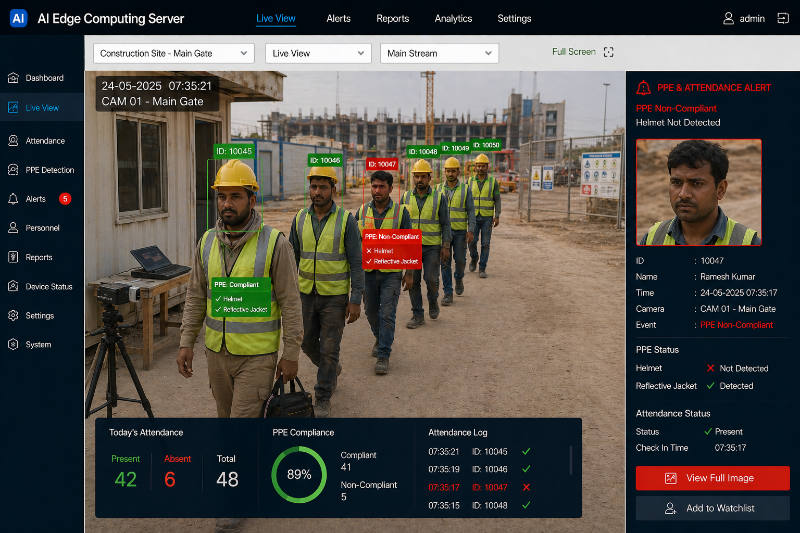
Device brochures often describe recognition in fractions of a second. A construction access transaction is longer. The worker approaches the gate, finds the correct lane, presents a face, finger, iris, badge, or QR claim, waits for identity resolution, receives an eligibility decision, passes the turnstile or gate, and clears the sensor. If the normal path fails, an operator must decide what happens next.
The useful performance measure is the complete time from entering the lane to clearing it—not the matching time alone. The lane must also handle the distribution of transactions. An average of five seconds may sound adequate, but a small number of 45-second exceptions can create a queue if they block the same lane used by ready workers.

Identity, eligibility, and passage are separate timings
A biometric comparison answers whether the presented sample matches an enrolled worker. The contractor or workforce platform checks whether that worker is currently eligible for the site, shift, gate, and zone. The access controller and physical barrier then execute and confirm passage. Measuring these stages separately makes the real bottleneck visible.
The previous Biometriya guide on contractor access beyond identity explains why company approval, assignment, induction, documents, and current policy belong in the decision. At shift change, those same checks must return predictably without turning the entrance into a compliance desk.
The gate is also part of the site's pedestrian plan
Construction access design cannot be separated from physical traffic management. HSE guidance on construction-site traffic states that routes should be suitable, correctly positioned, and sufficient in number and size. It also recommends separating pedestrian and vehicle gateways, providing suitable walkways, and controlling vehicle operations. Biometric throughput does not justify placing a fast pedestrian lane in a hazardous vehicle conflict point.
Size the lanes for the peak arrival interval, not the daily headcount
A site with 1,000 workers does not necessarily need the same gate design as every other 1,000-worker site. The important question is how many people arrive in the busiest five, ten, or fifteen minutes and how concentrated that demand becomes at each entrance. Staggered shifts, worker transport, parking location, toolbox talks, payroll rules, weather, and public-transport schedules can create very different arrival profiles.
Start with an arrival curve
Count expected arrivals in short intervals by gate and worker category. Do not spread the workforce evenly across an hour unless that reflects reality. A bus may deliver 50 people together. A mandatory briefing may cause several subcontractors to target the same time. Rain can compress arrivals under a covered approach. Historical access events can reveal the pattern once the system is operating.
Measure service time as a distribution
Record the median transaction, the 95th percentile, and the exception tail. Separate first-time workers, returning workers, denied workers, enrollment problems, damaged credentials, biometric retry, and operator-assisted cases. Lane design based only on the fastest successful match will understate the capacity required.
Leave operational headroom
A lane running continuously at its theoretical maximum has no room for hesitation, a slower walker, a barrier reset, a glove that must be removed safely, or a network delay. Practical capacity needs headroom. A pilot should demonstrate stable queues under expected peak demand plus a credible surge, not merely pass a sequence of cooperative test users.
| Lane stage | What can slow it | Useful measurement | Design response |
|---|---|---|---|
| Approach | Mixed vehicles and pedestrians, poor signage, crowding, wrong lane | Arrival rate and approach density by interval | Separated routes, lane signs, queue rails, lighting, and weather cover |
| Presentation | PPE, pose, height variation, glare, dirty sensor, unclear instructions | Capture retry rate and time to usable sample | Correct device position, guided feedback, maintenance, and suitable modality |
| Identity | Low-quality enrollment, duplicate record, changed appearance, large gallery | Match time, false rejection, and unresolved identity rate | Enrollment quality controls, threshold testing, and re-enrollment process |
| Eligibility | Expired induction, remote-system delay, missing assignment, policy conflict | Policy response and denials by reason | Pre-clearance, local policy cache, and early expiry notifications |
| Passage | Turnstile cycle, tailgating sensor, bag movement, accessibility needs | Barrier clearance and confirmed-passage time | Right barrier type, accessible lane, passage sensing, and separate exception route |
Keep exceptions out of the normal lane
A worker with an expired induction should not hold a queue while security searches emails and calls a supervisor. The normal lane should return a clear result and direct the person to an assisted point. The exception desk or mobile operator can see the reason, verify alternative evidence, contact the responsible owner, and issue a time-bound decision when policy permits.
Choose biometric capture around PPE, environment, and user flow
No biometric modality is universally best for every construction entrance. The decision depends on worker population, risk, gloves, face coverings, eye protection, helmets, dust, lighting, device maintenance, hygiene, lane geometry, and whether the gate is permanent or temporary.
Face verification for touchless recurring entry
Facial recognition can support a fast, touchless walk-up interaction. The terminal should be positioned for realistic worker heights and approach angles, protected from harsh backlight and weather, and tested with the PPE actually used at that point. Helmets and clear safety glasses may be compatible with a well-designed capture zone, but masks, tinted protection, scarves, shadows, or head position can reduce the visible facial information.
The safe operating procedure matters. Workers should not be instructed to remove mandatory PPE in a hazardous approach area merely to satisfy the reader. If a required item prevents reliable face capture, use a safer location, an alternative modality, a claimed-identity workflow, or assisted verification.
Fingerprint where controlled contact is practical
Fingerprint is mature and widely understood, but gloves, dust, moisture, worn ridges, cuts, and shared-sensor cleaning can affect the interaction. A fingerprint lane may work well in a sheltered entrance with a clear glove-removal point and cleaning procedure. It may be a poor fit where workers must keep protective gloves on until they reach a safe changing area.
Iris or multimodal verification for higher-assurance zones
Iris can provide a strong alternative when face or fingerprint capture is constrained, provided the device, distance, eyewear, and interaction are suitable. Multimodal devices can allow the site to select face, iris, fingerprint, or combined verification according to risk and operating conditions. BioDuo 2 is relevant for higher-assurance controlled areas where face and iris options are valuable.
Presentation attack detection belongs in the risk model
Where an attacker could gain meaningful access using a photo, replay, artificial finger, mask, or other presentation, the deployment should include appropriate anti-spoofing controls and testing. ISO/IEC 30107 establishes the terminology and framework for biometric presentation attack detection. PAD is one security layer; it does not replace eligibility checks, barrier controls, operator awareness, or physical site protection.
Use several gate patterns instead of forcing the whole project through one entrance
- Dedicated worker ingress and egress lanes
- Guided face terminals such as FacePass
- Turnstile or speed-gate passage confirmation
- Local controller and resilient eligibility cache
- Separate accessible and exception lanes
- Mobile verification using Aegis or BMBT 2
- Portable barrier or supervised access point
- Defined offline limits and synchronization
- Phase-specific project, shift, and zone policy
- Rapid relocation as the perimeter changes
Main workforce gates
These lanes handle the highest recurring volume and should be optimized for already-enrolled, already-cleared workers. FacePass can provide guided touchless verification linked to current access policy. Fixed lanes are the right place to invest in controlled lighting, weather protection, reliable networking, passage sensors, queue organization, and clear feedback.
Exception and assisted lanes
This lane resolves identity retries, missing assignment, expired evidence, accessibility needs, new worker arrival, and supervisor-approved exceptions. A BMBT 2 rugged biometric tablet can help reception or security perform assisted identity, document, and biometric checks without blocking the primary gate.
Temporary and phase-specific gates
Construction access routes move as excavation, structure, fit-out, commissioning, and handover progress. A gate that was well positioned three months ago may become unsafe or operationally irrelevant. Mobile biometric verification with Aegis, portable infrastructure, and phase-specific permissions can extend control while the permanent access design changes.
Controlled internal zones
Crossing the site perimeter should not grant unrestricted movement. Plant rooms, data halls, energized areas, lifting zones, storage compounds, and other sensitive locations may need stronger assurance or narrower role-based access. Internal zone policy can use the same worker identity while checking different training, permit, time, or escort requirements.
Vehicle and delivery entrances
Vehicle gates have different cycle times and safety controls. A plate or vehicle credential identifies the vehicle, not every occupant. Driver identity, passengers, delivery purpose, vehicle approval, and pedestrian movements may require separate treatment. HSE traffic guidance recommends separating pedestrian and vehicle gateways where possible and managing access around vehicle risk.
Exit and emergency routes
Exit events support attendance and live presence, but life-safety egress must not be compromised by identity technology. The access design should distinguish normal controlled exit, emergency release, muster processes, missed-exit correction, and re-entry. Emergency procedures, local regulation, fire strategy, and barrier certification take precedence over an ideal attendance record.
Plan for exceptions, offline operation, and changing conditions
Pre-clear workers before the shift
The fastest gate transaction is the one that does not need a compliance investigation. Contractor Management and Site Access can move company onboarding, worker registration, document approval, assignment, induction, and expiry resolution earlier. The gate then evaluates current status rather than assembling it from paper and email.
Define the offline decision
If connectivity fails, the system needs an explicit policy. Which approved workers and access rules are stored locally? How old may cached eligibility be? Can an urgent suspension reach devices? Which zones must fail closed? How are events queued and reconciled? Who can authorize a temporary manual process? The answer may differ between a main workforce gate and a high-risk internal area.
Protect the lane from environmental failure
Construction entrances face dust, rain, heat, glare, vibration, unstable power, dirty hands, and changing backgrounds. Select suitable enclosures and mounting, provide power conditioning and network protection, define cleaning frequency, inspect cameras and sensors, and monitor device health. A device that works during commissioning may degrade gradually unless maintenance is part of the operating model.
Test with the actual population and equipment
A representative pilot should include different heights, skin tones, ages, facial hair, helmets, eyewear, permitted coverings, gloves, worn fingerprints, mobility needs, day and night lighting, shift peaks, subcontractor categories, visitors, denied identities, expired workers, duplicate attempts, offline operation, and barrier faults. Use production-like enrollment quality and policy data.
Measure real worker demand by gate and short time interval before fixing lane count.
Reproduce approach, lighting, weather protection, device height, controller, and barrier.
Include active, expired, denied, unassigned, escorted, and higher-assurance worker cases.
Test normal traffic, bus arrivals, surges, exceptions, retries, and operator interventions.
Simulate network loss, server delay, power recovery, dirty sensors, and barrier faults.
Adjust capture, thresholds, policy caching, signage, staffing, and lane allocation.
Measure the gate as an operation
Track arrivals per five or ten minutes, successful transactions per lane, median and 95th-percentile clearance time, capture retries, false rejections, denials by policy reason, manual interventions, exception resolution time, maximum queue length, controller and integration latency, barrier faults, offline duration, unconfirmed passages, tailgating events, and missing exits.
Review the numbers by gate, shift, company, device, modality, and project phase. One entrance may perform well while another suffers from glare, weak connectivity, a different workforce mix, or a poor physical approach. Aggregate averages can hide the problem.
A practical construction-gate design checklist
- Demand: Do we know the busiest arrival interval at each gate rather than only total headcount?
- Safety: Are pedestrian approaches separated from vehicles and suitable for the expected volume?
- Readiness: Are workers enrolled and cleared before they join the normal lane?
- Capture: Has the biometric method been tested with required PPE, lighting, weather, and population?
- Capacity: Do lane counts include operational headroom and realistic exception rates?
- Passage: Does the barrier confirm one person passed without creating unsafe egress?
- Exceptions: Is there an assisted path that cannot silently become a bypass?
- Resilience: Are power, network, offline policy, cached revocation, and event reconciliation defined?
- Change: Can the access model move with construction phases, temporary gates, and controlled zones?
- Accountability: Can the site distinguish attendance events from current inside/outside state?
The objective is not simply a shorter queue. It is a predictable gate that admits the right workers, preserves safe movement, isolates exceptions, and continues to produce a trustworthy site record while the project changes around it.
Frequently asked questions
How many biometric lanes does a construction site need?
There is no reliable lane count based only on total workforce. Measure the peak arrival rate by short interval, complete transaction-time distribution, exception rate, barrier cycle, and required headroom. Then test the proposed layout with representative shift traffic.
Can face recognition work when construction workers wear helmets and safety glasses?
It can, depending on the device, face visibility, eyewear, lighting, angle, enrollment quality, and tested population. Mandatory PPE should not be removed in an unsafe area. Where coverage prevents reliable capture, use another modality, claimed identity, or assisted verification.
Should workers with expired induction be stopped at the gate?
The configured outcome should follow the site's documented policy and applicable requirements. Mandatory readiness items may block access, while other conditions may route the worker for review. Pre-expiry notification and pre-mobilization checks reduce gate disruption.
Can biometric access work without a permanent network connection?
Yes, if the architecture supports local matching or cached policy and the offline rules are explicitly designed. The site must define cache age, revocation handling, fail-open or fail-closed conditions, local event storage, synchronization, and operator procedures.
Is a successful biometric entry enough for emergency headcount?
No. Entry contributes evidence, but a reliable current count also depends on confirmed passage, exits, missed transactions, visitors, mobile gates, vehicle passengers, manual corrections, and people whose state is unknown. Emergency accountability remains an operational process.
Reference standards and independent resources
- UK HSE: Traffic management on site — guidance on safe pedestrian and vehicle routes, separate gateways, visibility, barriers, signs, and instructions.
- UK HSE: Protecting the public — guidance on construction boundaries, authorization, restricted areas, induction, and preventing unauthorized access.
- NIST OSAC standards library: ANSI/ASTM E3115-17 (2023) — standard guide for capturing facial images for use with facial recognition systems.
- ISO/IEC 30107-1:2023 — framework and terminology for biometric presentation attack detection.